
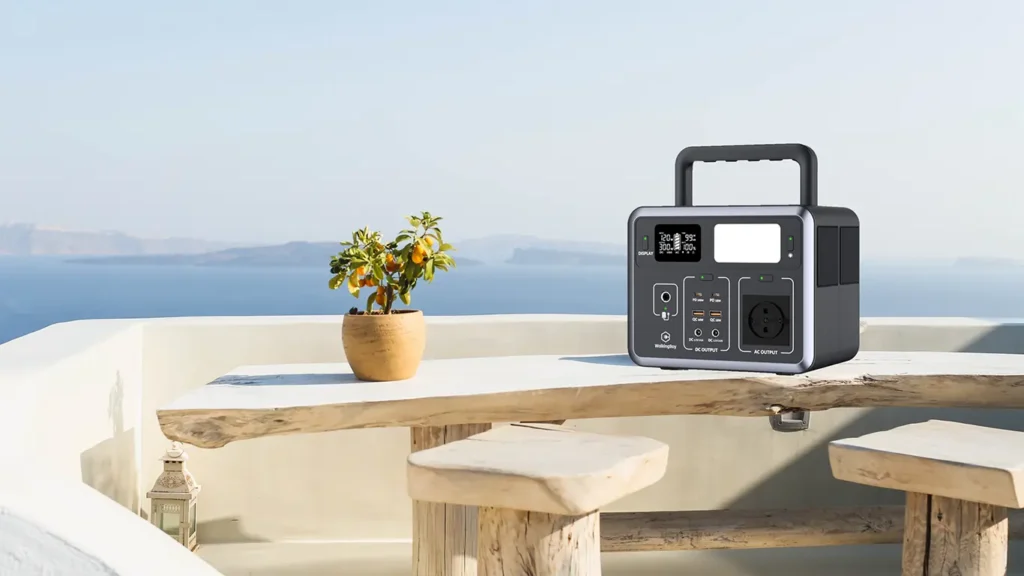
When choosing a portable power station, key factors to consider include battery capacity, power output, portability, charging method, port type, security and brand selection.
- Basic performance indicators
Battery capacity (Wh)
Select the capacity based on the total power consumption of the device and the expected usage time. The calculation formula is: device power (W) × usage time (hours) = Wh required. For example, running a 100 W refrigerator for 8 hours requires a minimum capacity of 800 Wh. In some scenarios, the recommended capacity is 5 times the total power to cope with sudden demands.
Output power (W)
The total power requirements of all devices should be covered, with a margin of 20%. For low-power devices (mobile phones/laptops), choose 300-500 W, and for high-power appliances (refrigerators/electric stoves), choose more than 2000 W. Be careful to distinguish between continuous power (rated power) and instantaneous peak power (surge power).
Battery type
Lithium-ion battery: lightweight and high energy density, suitable for frequent movements.
Lithium iron phosphate (LiFePO4) battery: 2500 to 3500 times cycle life, high temperature resistance, long term use with higher cost-benefit ratio
Lead-acid batteries: low-priced but large and short-lived, they are gradually being phased out.
- 2. Functional design elements
Port configuration
It should at least include interfaces such as AC outlet (to support home appliances), USB-A/C (digital devices) and DC5521 (in-vehicle devices). High-end models offer wireless charging and fast PD charging ports. When running multiple devices at the same time, it is recommended to select more than 6 output ports.
Inverter technology
Pure sine wave inverters can reduce electromagnetic interference and protect precision equipment (such as medical instruments and drones), which is better than modified sine wave models.
Loading method
Priority is given to support a combination of solar charging (input power above 200 W), vehicle charging and AC fast charging. For example, the Thomsen X150 solar charger takes only 4.5 hours to fully charge. Some models support simultaneous multi-mode charging to improve efficiency.
- 3. Portability and security
Weight and dimensions
Lightweight designs (20 kg) should be equipped with pulleys. A compromise solution is to choose a design with a handle of about 15 kg, such as the Jackery 1000 (10.5 kg/1002 Wh).
Safety certification
It must pass UL, CE, FCC and other certifications, and have a built-in BMS system to prevent excessive overloading/discharging. Metal body dissipates heat better than plastic and is suitable for high temperature environment.
- 4. Suggestions for scenario selection
Short distance camping: 500-1000 Wh capacity + 300-500 W power, such as EcoFlow River series.
Emergency for RV/home: 2000 Wh or more + pure sine wave inverter, BLUETTI AC200P (2000 W/17 ports) is recommended.
Professional outdoor work: choose expandable battery models (such as AC200L that supports expansion to 8192 Wh) and IP54 waterproof rating.
- 5. Brand and Service
- 6. Optimization of the cost-benefit ratio
Pay attention to the integrated solar panel package, which saves 30% of the cost compared to buying them separately.
By thoroughly evaluating the power demand, usage scenarios and budget, and comparing the above parameters, you can accurately select the most suitable portable power plant. It is recommended to purchase from the brand's official website or certified channels to ensure after-sales support.


 English
  Español
  简体中文
简体中文