
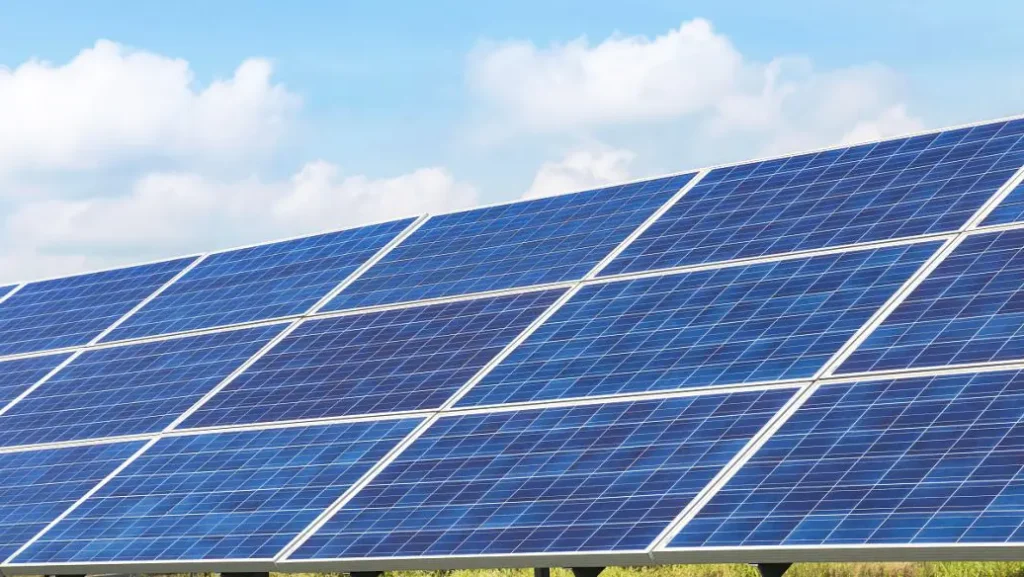
The photovoltaic industry has experienced an unprecedented technological leap forward. Among the most outstanding advances is theN-type monocrystalline silicona material that is redefining the limits of efficiency in solar panels. According to recent studies, this technology can increase electrical generation by up to20% with respect to traditional P,But how does it achieve this? In this article, we will explore from scientific fundamentals to practical applications, adapting technical concepts for accessible understanding.
1. What is N-type silicon and why does it outperform P-type silicon?
N-type silicon is manufactured byphosphorus dopingwhich creates an excess of electrons as charge carriers. Unlike P-type silicon (boron-doped), it offers key advantages:
Longer service life of minority carriersN-type silicon has a lifetime of carriers (electrons and holes).10 times greater than the P-type, reducing recombination losses
Zero light-induced degradation (LID)While P-type cells lose up to 3% of efficiency in the first months due to the formation of boron-oxygen pairs, N-type cells do not suffer from this problem.
Lower temperature coefficientIts electricity production decreases by only one percent.0.3-0.4% per degree Celsius increase, compared to 0.4-0.5% of the P,This is crucial in hot climates.
A study of theSemiconductor Institute of the Chinese Academy of Sciences N-type cells achieve efficiencies of20% even in early stages of development, with the potential to overcome the25% .
2. Three technical keys behind 20% efficiency
2.1 Optical loss optimization
N-type solar cells employ innovative strategies to capture more light:
Surface texturingChemical etching creates a "velvety" surface that reduces the reflection of light by a40% .
Advanced anti-reflective coatingsSilicon nitride (SiNx) and aluminum oxide (Al₂O₃) films minimize residual reflection.
Optimized electrodesTechnologies such asMWT (Metal Wrap Through) eliminate front contacts, increasing the active area .
2.2 Reduction of electrical losses
Two advances stand out here:
Passivation structuresTunnel oxide layers (TOPCon) and doped polycrystalline silicon reduce recombination at surfaces and edges, raising the open circuit voltage (Voc) to700 mV
Selective contact technologiesIn HJT (Heterojunction) cells, a thin layer of amorphous silicon improves charge separation.
2.3 Integration with state-of-the-art techniques
Projects such as theMWT Panda Yingli combine N-type silicon with:
Doping by ion implantationUltra-selective emitters can be created, such as in the cells of20% efficiency developed by Dr. Han Peide's team.
Double-sided (bifacial): They take advantage of the reflected light, increasing the generation up to a30% in installations on light-colored surfaces.
3. Case studies: From the laboratory to the market
3.1 China Semiconductor Institute project
Using N-type wafers of380 µmthe team was able to20% efficiency with techniques such as selective emitters and local backside contacts. According to Dr. Han, by optimizing silicon thickness and scaling up processes, it will achieve24% in mass production.
3.2 Yingli Panda MWT Technology
In collaboration with Chinese universities, Yingli integrates N-type cells with MWT structures, eliminating front-end buses. This reduces series resistance and boosts efficiency to21% in the laboratory, with a pilot line of30 MW operating .
4. Economic and environmental advantages
Lower levelized cost of energy (LCOE)Although the N-type wafers are a10-15% more expensive than the P-type, their higher efficiency and durability reduce the LCOE by a8-12% long-term
Reduced carbon footprintAccording to theInternational Renewable Energy Agency (IRENA)The N-type panels generate a18% plus energy per ton of CO₂ emitted. during its manufacture.
5. Future: Towards the 30% of efficiency
The next generation will combine N-type silicon with:
Perovskite-silicon tandem cellsPotential for efficiencies of30%using the infrared (silicon) and visible (perovskite) spectrum.
IBC and HBC technologies: Interdigitated back contacts and heterojunctions, like cells.HBC Panasonic with25.6% efficiency .
N-type monocrystalline silicon is not just an incremental improvement: it represents a paradigm shift to more efficient, durable and cost-effective panels. With breakthroughs like those of the China Institute and Yingli, this technology is poised to dominate the market, meeting the goals of the 2030 Agenda for clean energy.

 English
  Español
  简体中文
简体中文